
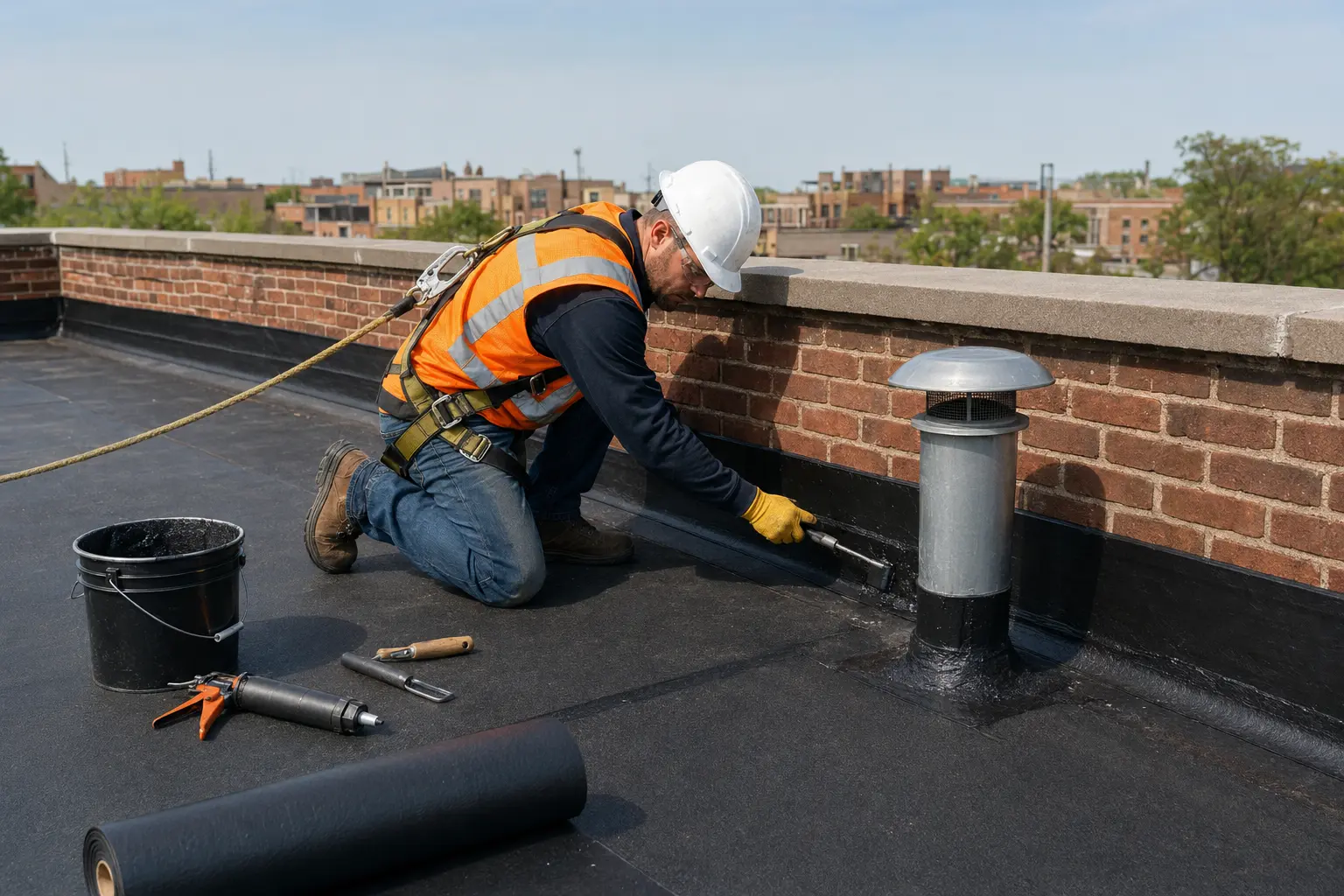
When a ceiling stain appears, the opening in the roof may be several feet away. Water can travel along membrane layers, insulation, decking, framing, or a wall before it becomes visible indoors. That is why a useful flat-roof inspection compares interior evidence with roof seams, drainage, penetrations, and vertical transitions instead of treating only the spot above the stain.
Chicago roofs also experience wind, rain, snow, temperature swings, and freeze-thaw cycles. Those conditions do not automatically cause a leak, but they can expose loose, cracked, poorly supported, or incompatible details around the roof’s most complicated areas.
1. Vent pipes and other small penetrations
Pipes pass through the roof membrane and need compatible flashing that turns up the penetration and seals at the top. Depending on the roof system and pipe shape, that may involve a manufactured boot, field-fabricated membrane flashing, or a properly designed penetration pocket.
Inspect for splits, openings, loose membrane, unsupported movement, deteriorated clamping details, and old repair materials that no longer bond to the roof. Repeatedly adding surface sealant can hide the condition without rebuilding the flashing that is supposed to manage water.
2. Chimneys, parapets, and roof-to-wall transitions
Where the field membrane meets a chimney or parapet, the roof must turn from horizontal to vertical. Base flashing, counterflashing, coping, termination details, and the wall itself all affect performance. A roof repair may address failed membrane flashing, but it cannot make loose coping, open mortar joints, or unstable masonry sound.
Look for membrane pulling away from walls, open laps, damaged termination bars, cracked coatings, deteriorated sealant, displaced coping, and water paths above the roofing transition. The scope should identify whether the issue belongs to the roof membrane, the wall, the coping, or more than one component.
3. Drains, scuppers, and gutter edges
Water concentrates at drains, scuppers, and gutter edges, so weak seams or flashing there receive repeated exposure. Debris, restricted outlets, low areas, compressed insulation, or insufficient slope may keep water against a detail longer than intended.
A new patch does not create slope by itself. When water remains on the roof, the repair plan may need to include tapered insulation, drain or scupper work, or another drainage correction. Our guide to ponding water on Chicago flat roofs explains the conditions worth checking.
4. Rooftop equipment and curbs
HVAC units, hatches, supports, conduits, and equipment curbs can introduce movement and multiple penetrations. Inspect the curb flashing, corners, seams, clearance above the roof, supports, abandoned openings, and any lines that rest directly on the membrane. Mechanical condensation or equipment leaks can also resemble a roofing problem and should be ruled out.
Why sealant alone may not be the repair
Sealants have legitimate uses when they are compatible, properly prepared, and installed in the right detail. They are not a substitute for damaged membrane, failed flashing, wet insulation, unstable masonry, or poor drainage. A durable repair may require removing incompatible materials, preparing a sound substrate, replacing damaged components, and rebuilding the flashing with materials intended for the existing roof system.
On TPO roofs, field seams and many flashing details are heat welded. Prefabricated accessories can help address common shapes, while irregular conditions require a detail approved for that system. The repair method should follow the roof material and actual failure point—not a one-product approach.
Seven areas a useful leak inspection should check
Interior evidence: Map stains, active dripping, odors, and when the problem appears.
Membrane and seams: Check punctures, open laps, surface wear, blisters, ridges, and previous patches.
Penetrations: Inspect pipes, curbs, hatches, supports, and abandoned openings.
Vertical transitions: Review parapets, chimneys, coping, base flashing, and terminations.
Drainage: Look at low areas, drains, scuppers, gutters, downspouts, and debris.
Hidden moisture and deck: Consider insulation, decking, attachment, and whether targeted test cuts or moisture scanning are appropriate.
Roof history: Note the roof system, age, layers, prior repairs, and whether leaks occur in one area or across the building.
Repair, recover, or replace?
A localized detail failure on an otherwise serviceable roof may support a targeted repair. Repeated leaks across unrelated areas, widespread wet materials, an unreliable substrate, or failing drainage can point toward broader restoration or replacement. Read our Chicago flat-roof repair-versus-replacement guide to compare those conditions.
If a new TPO system is being considered, the existing roof still needs to be evaluated for moisture, deck condition, layers, attachment, drainage, and perimeter heights. See when a TPO overlay may be appropriate. The City of Chicago’s permit path depends on the property and scope, so confirm the current requirements before work begins.
Find the leak before choosing the repair.
Leaf Gutter & Roofing Solutions inspects and repairs flat roofs in Chicago and nearby suburbs, including membrane seams, penetrations, parapets, drains, scuppers, gutters, and related flashing.
Call or text (773) 900-4004, or send the property address, leak history, and helpful photos through our estimate form.
Request a free estimate