
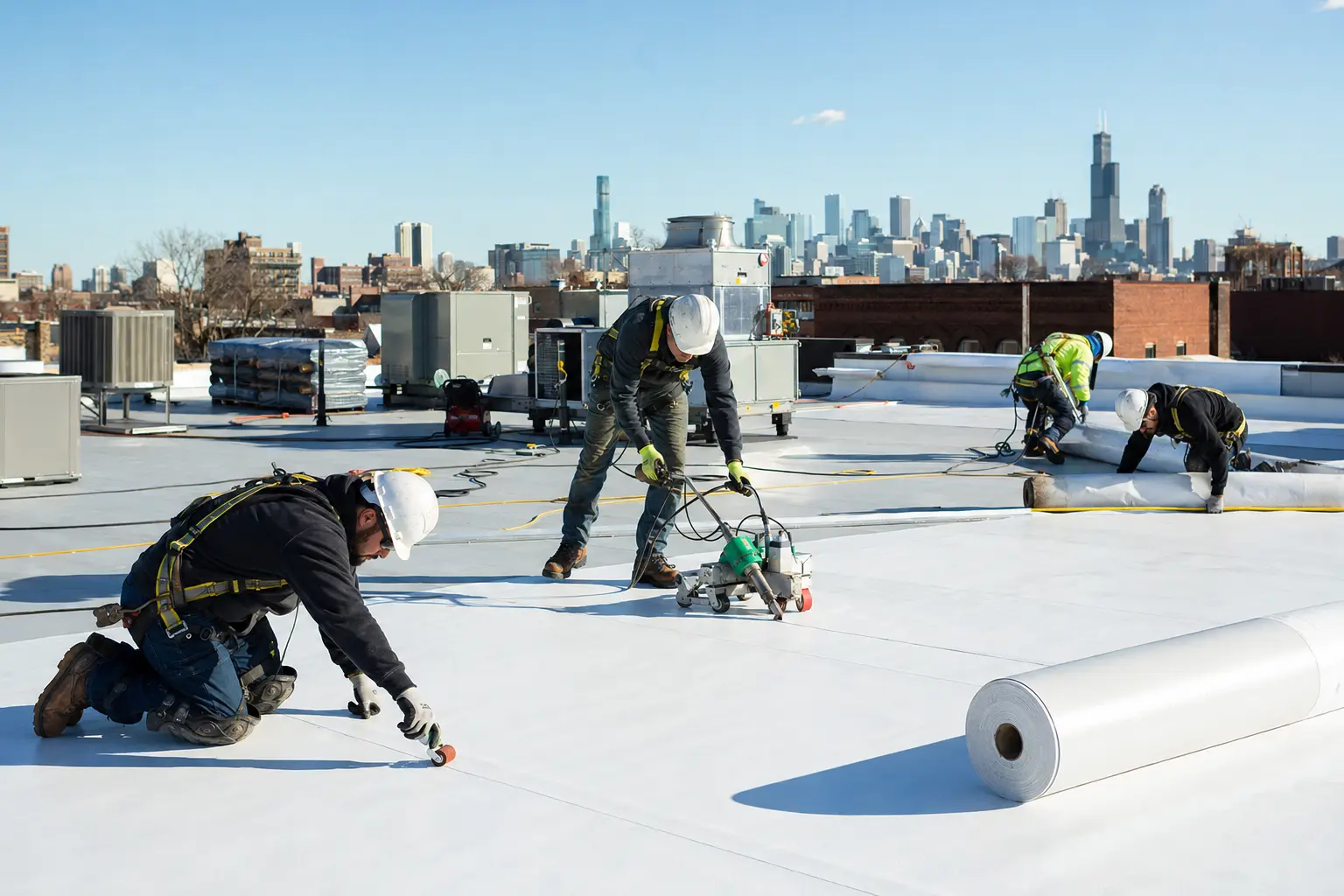
A TPO recover—often called an overlay—installs a new roof assembly over an existing roof instead of removing everything to the deck. It can reduce demolition, debris, time, and disruption when the roof below is a suitable substrate. It is not automatically the right option just because the existing surface looks flat.
Chicago’s Department of Buildings recognizes roof recover as a reroofing scope, but the city’s guidance does not allow a recover when the existing roof is water-soaked or deteriorated to the point that it is not an adequate base. The decision should be made from the roof’s actual condition, not from price alone.
When a TPO overlay may make sense
An overlay may be considered when the existing roof and deck are structurally sound, the assembly is dry or isolated wet materials can be fully removed, the surface can be properly prepared, the new system is compatible, and the roof has an acceptable number of existing layers. Perimeter heights, penetrations, curbs, drains, scuppers, gutters, attachment, and wind exposure must also work with the added assembly.
Depending on the approved roof design, the existing surface may receive insulation or a suitable cover board before the TPO membrane is installed. TPO seams and flashing details are then heat welded. The exact assembly and attachment method should follow the selected manufacturer’s requirements and the building conditions.
Seven conditions to check before covering the old roof
Moisture: Is insulation or another part of the existing assembly wet?
Deck: Is the wood, metal, concrete, or other roof deck stable and suitable for attachment?
Existing layers: How many roof coverings are already present, and does the proposed scope meet current requirements?
Surface: Can blisters, ridges, loose materials, contamination, and deteriorated areas be corrected to create a suitable substrate?
Drainage: Will the new assembly preserve or improve slope to drains, scuppers, or gutters?
Edges and penetrations: Will added insulation affect flashing heights, door thresholds, walls, curbs, coping, or rooftop equipment?
Attachment and load: Can the deck and structure support the approved system and its wind-uplift attachment?
Why wet insulation changes the decision
Installing a new membrane over wet materials can trap moisture inside the roof assembly. Wet insulation can lose thermal performance, and hidden moisture can contribute to deck deterioration and attachment problems. Carlisle’s reroofing guidance says wet or damaged insulation should be removed and replaced; NRCA also advises against recovering over wet materials.
Moisture is not always obvious from the surface. Interior staining, deck observations, repair history, infrared or other moisture scanning, and carefully selected test cuts may be used to understand hidden conditions. The appropriate method depends on the roof.
When a full tear-off is the better direction
- The roof contains widespread wet insulation or deteriorated materials.
- The deck is soft, corroded, sagging, damaged, or cannot be adequately evaluated.
- Existing layers or roof condition do not permit another recover.
- The surface is too unstable, uneven, contaminated, or incompatible for the proposed assembly.
- Drainage or perimeter conditions need changes that cannot be responsibly built over the existing roof.
- There are repeated leaks across unrelated areas and the old system is no longer a reliable base.
A tear-off exposes the deck and hidden conditions so damaged materials can be removed before the new insulation and membrane are installed. It produces more debris and disruption than an overlay, but it can be the responsible choice when covering the old system would preserve the same underlying problems.
Does a TPO overlay fix ponding water?
Not by itself. A new membrane follows the surface below it unless the roof plan adds or reshapes slope. Low areas may require tapered insulation, drain or scupper changes, or other drainage work. Read our guide to ponding water on Chicago flat roofs for the warning signs and questions to check.
Chicago permit context
The City of Chicago lists roof repair, recover, and replacement within its reroofing guidance. Its Express Permit Program materials identify recover over one existing layer as an eligible scope and state that recover is not allowed over a water-soaked or inadequately deteriorated roof covering. Permit eligibility does not replace a roof evaluation, and the correct application and requirements still depend on the property and proposed work.
Questions to ask before accepting an overlay estimate
- How were moisture, deck condition, and the number of existing layers evaluated?
- Which parts of the old roof will be removed or repaired before the new assembly goes down?
- What insulation or cover board will separate and support the new TPO membrane?
- How will drains, scuppers, gutters, parapets, penetrations, and perimeter edges be detailed?
- Will the work correct existing low areas or leave the drainage pattern unchanged?
- What hidden conditions could require a change from overlay to tear-off?
Those answers help property owners compare complete roof assemblies instead of comparing membrane descriptions alone. For a broader decision guide, see flat-roof repair versus replacement in Chicago.
Find out whether your roof is a recover candidate.
Leaf Gutter & Roofing Solutions evaluates Chicago flat roofs for TPO overlays, complete tear-offs, repairs, insulation and drainage improvements. We explain what can remain, what needs removal, and which visible or hidden conditions affect the scope.
Call or text (773) 900-4004, or send the property address, leak history, and helpful photos through our estimate form.
Request a free estimate