
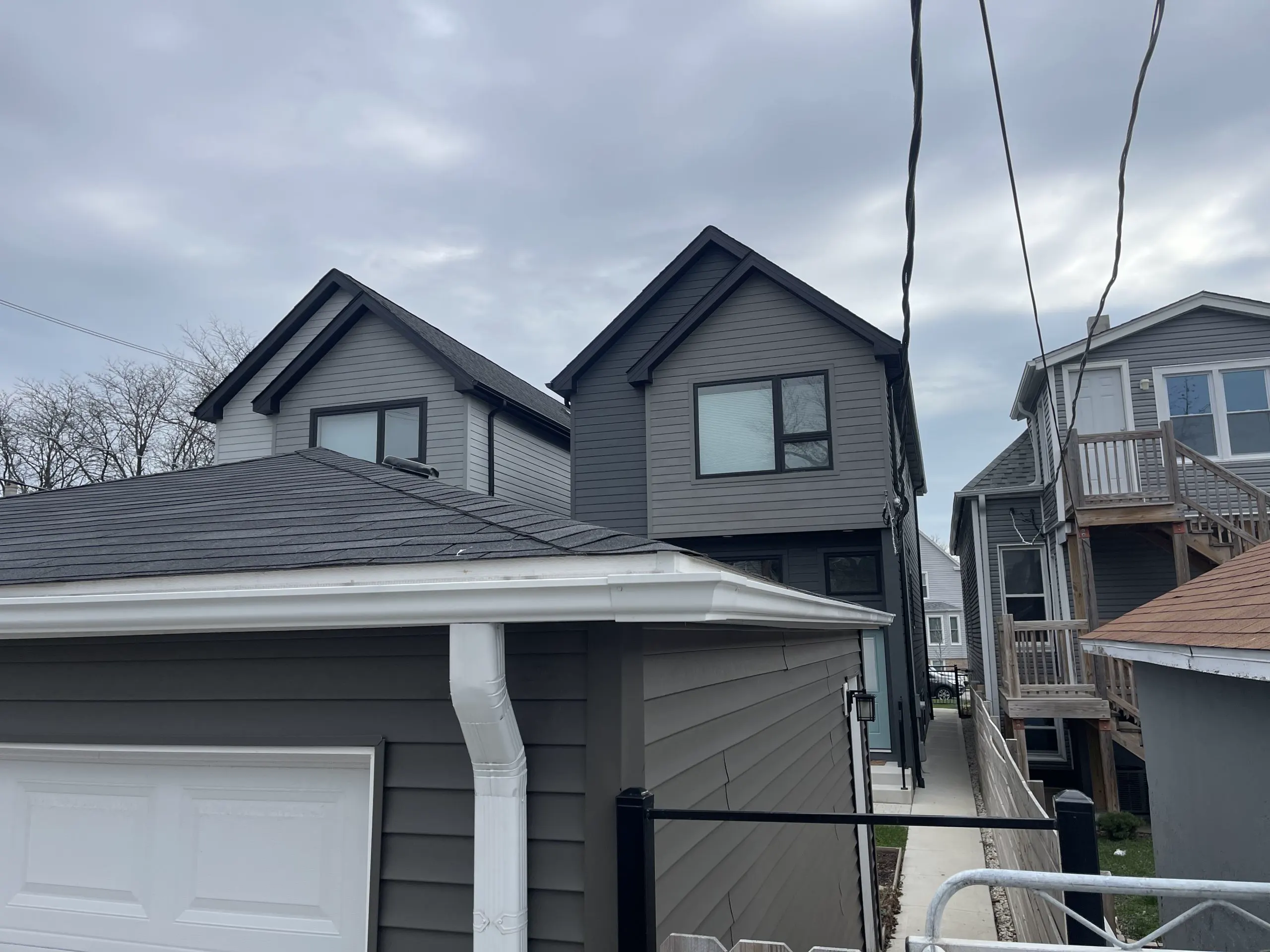
A gutter can be clean and still overflow. On Chicago homes, water may reach one short section from several roof planes, a valley may concentrate runoff near a corner, or a long gutter run may depend on a single outlet. In those situations, the useful question is not simply whether the gutter should be larger. The roof area, gutter profile, slope, outlet openings, downspout dimensions, elbows, and discharge route all have to work together.
Six-inch seamless gutters with 3×4-inch downspouts are a common upgrade for larger or more demanding roof areas, but they are not automatically necessary for every property. A site-specific drainage review is more reliable than choosing a size from the building's square footage alone.
What changes when the gutter and downspout get larger?
A larger gutter provides more cross-sectional area to receive and temporarily carry runoff. A nominal 3×4-inch downspout also has twice the rectangular cross-sectional area of a nominal 2×3-inch downspout—12 square inches compared with 6 square inches—before accounting for the actual manufactured profile, outlet, elbows, and installation conditions.
That added space can reduce restriction, especially at locations receiving concentrated water. It does not guarantee good performance when the outlet hole is too small, the gutter is pitched incorrectly, the downspout is clogged, or the underground connection cannot accept the flow.
Roof area matters, but roof geometry matters too
Professional sizing methods use the roof area served by each gutter section, local rainfall intensity, the gutter shape and dimensions, and the number and placement of downspouts. The Sheet Metal and Air Conditioning Contractors' National Association provides a sizing calculator based on its Architectural Sheet Metal Manual and current rainfall information.
Two homes with similar floor area can need different drainage layouts. A simple gable roof may spread water along two long eaves. A roof with dormers, intersecting slopes, porch roofs, or additions can send several surfaces toward one short gutter or inside corner.
Valleys create concentrated flow
A roof valley collects water from two adjoining slopes and directs it toward a narrow point at the eave. During heavier rain, that concentrated flow can overshoot or overwhelm a short gutter section even when most of the system performs normally.
The solution may involve a wider gutter, a larger or better-positioned outlet, another downspout, or a carefully installed splash guard. A tall splash guard should not be used to hide an outlet or pitch problem, and it should not force water back under the roof edge.
Long gutter runs need an outlet plan
One downspout at the end of a long run makes all water travel to a single outlet. Depending on the roof area and available discharge locations, dividing the run between two downspouts may be more effective than relying on one distant outlet. The gutter needs a consistent pitch toward each outlet without dropping so far that it looks uneven or exposes the fascia.
SMACNA notes that gutter length, the number of sections, downspout count, and gutter proportions all affect required sizing. Building America guidance also recommends adequately sized gutters and downspouts, with downspout spacing planned around the water load rather than appearance alone.
The outlet can be the bottleneck
A large downspout cannot use its capacity if it is connected through a small outlet opening. The drop outlet, first elbow, offsets around the soffit, and transitions into lower piping can each restrict flow or collect debris. Crushed elbows and excessive bends are common places for leaves and roof granules to accumulate.
During an inspection, the outlet should be checked from inside the clean gutter. A controlled water test can help show whether water reaches the outlet, backs up above it, leaks at joints, or slows farther down the route.
Do gutter guards change the sizing decision?
Gutter guards can reduce larger debris entering a compatible system, but they do not increase downspout capacity. Some water may also move differently across a screen during intense rain or where a valley discharges. Guard type, roof pitch, nearby trees, and the location of concentrated flow should be considered before installation.
The gutter should be correctly pitched, firmly attached, and able to drain before guards are added. Our guide to sagging gutters and deteriorated fascia explains why the mounting surface and roof-edge details matter.
Where the downspout ends is just as important
Moving more water through a larger downspout is useful only when that water has a safe place to go. An extension, catch basin, underground pipe, or approved drainage connection should move runoff away without directing it toward the foundation, a neighbor's property, or an icy walkway.
Building America guidance recommends carrying above-grade discharge at least 5 feet away from the foundation when practical, or using a properly designed underground catchment route farther away. Existing underground piping should be checked before a larger downspout is connected because a blocked or undersized line can make water back up at the building.
Seven details a useful drainage inspection should check
Contributing roof area: Identify every roof plane feeding each gutter section.
Valleys and concentrated flow: Note where multiple slopes discharge into a short area.
Gutter condition and size: Check profile, damage, seams, low spots, and available capacity.
Pitch and run length: Confirm that water has a consistent route to practical outlet locations.
Outlets and downspouts: Review opening size, downspout dimensions, spacing, elbows, and restrictions.
Roof edge and fascia: Check flashing, back edge, attachment, and the condition of the mounting surface.
Final discharge: Trace water through extensions or underground piping to a safe destination.
When 6-inch gutters and 3×4 downspouts are worth considering
A larger system is worth evaluating when a substantial roof area drains to one eave, valleys repeatedly concentrate water, the existing five-inch gutter overflows despite being clean and correctly pitched, long runs have too few outlets, or debris frequently restricts smaller downspouts. The inspection may also show that adding or relocating an outlet is more important than replacing every gutter.
For an existing system, document where overflow occurs during rain and take photos from the ground when it is safe. Those observations help separate a capacity problem from clogs, loose gutters, roof-edge defects, or failed underground drainage.
Size the gutter, outlet, and discharge route together.
Leaf Gutter & Roofing Solutions installs six-inch seamless aluminum gutters, 3×4 downspouts, gutter guards, soffit, fascia, and related roof-edge drainage improvements throughout Chicago and nearby suburbs.
Call or text (773) 900-4004, or send the property address, overflow location, and helpful photos through our estimate form.
Request a free estimate